Bubble Race

Through interactive exhibits, visitors can understand the relationship between the rising speed of bubbles in liquid…

Bubble Race — Basic Science exhibit for science museums
Studio rendering
CategoryBasic Science
InteractionInteractive installation
Standard sizeCustom size
SupplySingle unit or batch · OEM to your drawing
Lead timeStandard 4–8 weeks after deposit (confirmed per contract)
Warranty1 year, structure and control
DocumentsSpecification sheet · control diagram · spare-part list

A standard catalogue model: the dimensions, control package and finish are fixed, which is what keeps the price and the lead time predictable. Size, colour and interface language can be adapted without a new design cycle.

Ask about this model → Email us

Standard models from this range are also listed in our online store, priced in USD — see the price yourself ↗
01 / Overview

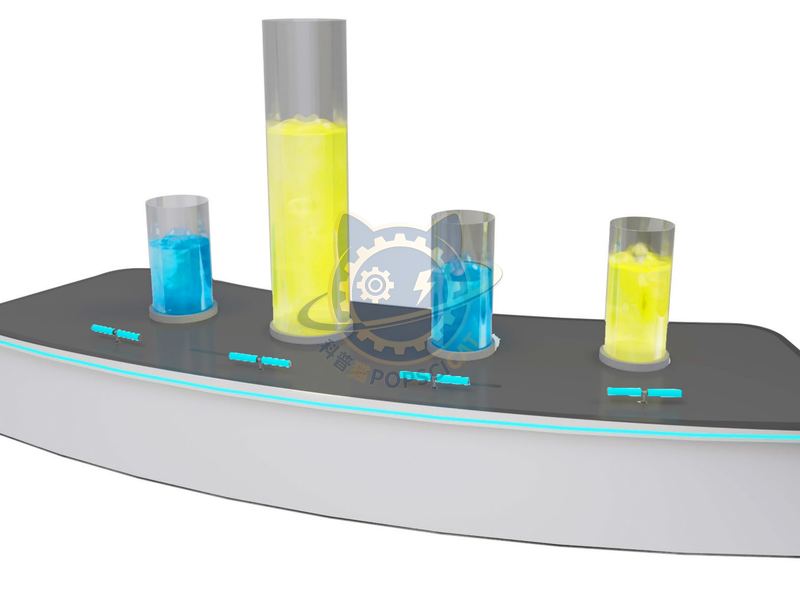
Through interactive exhibits, visitors can understand the relationship between the rising speed of bubbles in liquid and the density of the liquid, as well as the volume of bubbles, through comparative experiments, in order to comprehend knowledge of fluid mechanics such as Newton's law of viscosity and Boyle's law. The exhibit consists of a transparent cylinder assembled with silicone oil, a transparent cylinder assembled with water, and an inflation device. Press the handles downwards to inflate the cylindrical container, creating bubbles in the container filled with silicone oil. As the bubbles rise, their volume gradually increases; A gas ring is generated in a container containing water, and as the gas ring rises, its volume gradually increases. This is because the density of air is lower than that of silicone oil and water, so bubbles and gas rings will gradually rise. As they rise, the pressure they receive also decreases. According to Boyle's law, the pressure of a quantitative gas in a closed container is inversely proportional to its volume at a constant temperature. Therefore, bubbles and gas rings in the container.

02 / How visitors use it

Interaction type: Interactive installation. The unit is designed for unsupervised public use: controls are recessed or shielded, moving parts are enclosed, and the interface is operable by a child of about six with no instruction. Where a screen is used, the language can be switched without changing the hardware, and the content can be replaced on site.

03 / The science behind it

1. At a constant temperature, the volume of an ideal gas is inversely proportional to its pressure. It was proposed by British chemist Boyle in 1662 based on experimental results: "The pressure and volume of a quantitative gas in a closed container are inversely proportional at a constant temperature." This is called Boyle's law. This is the first discovered 'law' in human history. 2. Silicone oil is colorless, odorless, non-volatile, insoluble in water, and has good chemical properties. Each container contains silicone oil of different concentrations. Different concentrations result in different shapes of bubbles and varying rates of ascent. 3. Viscous resistance is the resistance that an object experiences when moving in a viscous fluid. When an object is immersed in a viscous fluid, a layer of fluid adheres to its surface. During motion, there exists a certain velocity gradient between the flow layers near the surface of an object. The viscous resistance experienced by an object is the internal friction between the flow layers near the surface of the object.

04 / Built for a public floor

Every unit leaves the factory after a running test: mechanisms cycled, electronics burned in, edges dressed, fixings torqued and marked. Wear parts — bearings, sliders, lamps, belts, touch panels — are modular and listed on the spare-part sheet, so a venue technician can replace them without returning the exhibit. Crating is plywood with foam blocking; the loading plan and packing list travel with the shipment.

Same category

More in Basic Science

Other models from the Basic Science line, all held to the same specification and the same control package.

Start a project

Send us your exhibit list.
We will come back with a price.

Attach a theme outline, a floor plan, or nothing at all — a photo of the space is enough to start. Quotations are issued against a real exhibit list, not per-square-metre guesses.

WeChat QR code — scan to message us Scan to add us
on WeChat