Home/Exhibits/Basic Science/Sailing against the wind

Sailing against the wind

By combining interactive electromechanical devices with fun interactive methods, understand the Bernoulli principle…

Sailing against the wind — Basic Science exhibit for science museums
Studio rendering
CategoryBasic Science
InteractionInteractive installation
Standard sizeCustom size
SupplySingle unit or batch · OEM to your drawing
Lead timeStandard 4–8 weeks after deposit (confirmed per contract)
Warranty1 year, structure and control
DocumentsSpecification sheet · control diagram · spare-part list

A standard catalogue model: the dimensions, control package and finish are fixed, which is what keeps the price and the lead time predictable. Size, colour and interface language can be adapted without a new design cycle.

Ask about this model → Email us

Standard models from this range are also listed in our online store, priced in USD — see the price yourself ↗
01 / Overview

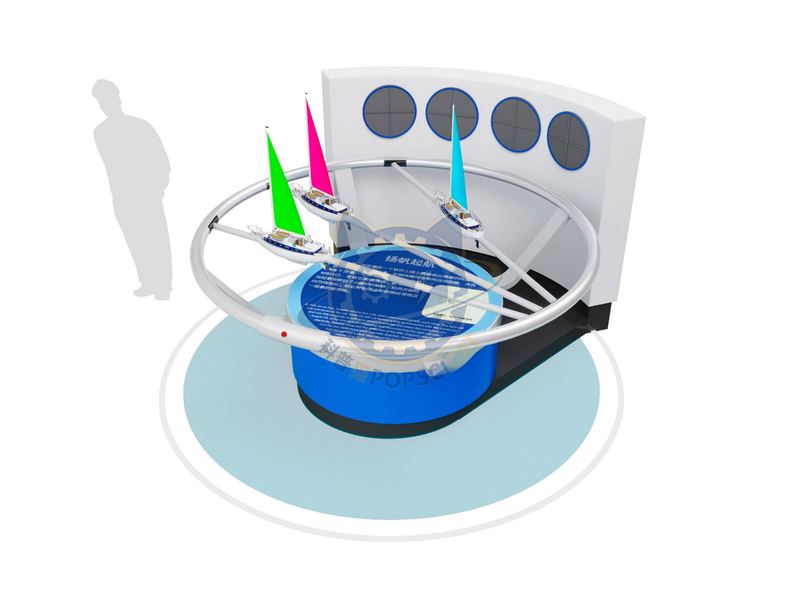
By combining interactive electromechanical devices with fun interactive methods, understand the Bernoulli principle and the relationship between heading and sail. The exhibit consist of wind turbines, turntables, sailboat models, etc. Press the start button, and the fan starts running. Rotate the turntable to adjust the direction of the ship's travel. When the wind direction has an angle greater than zero with the direction of the ship's travel, the sail swells under the action of the wind. The wind speed on the windward side of the sail is fast, while the wind speed on the other side is slow. According to Bernoulli's principle, the side with lower gas flow velocity generates a lateral pressure on the side with higher flow velocity, and the sailboat navigates against the wind under this pressure. Target audience: Adolescents aged 6-15. Display format: Electromechanical interactive device operation instructions (audience experience) 1 Press the start button, and the fan will start running; 2. Rotate the turntable to adjust the direction of the ship's travel; When there is an angle greater than zero between the wind direction and the direction of the ship's travel, the sail swells under the action of the wind, and the wind speed on the windward side of the sail.

02 / How visitors use it

Interaction type: Interactive installation. The unit is designed for unsupervised public use: controls are recessed or shielded, moving parts are enclosed, and the interface is operable by a child of about six with no instruction. Where a screen is used, the language can be switched without changing the hardware, and the content can be replaced on site.

03 / The science behind it

1. Bernoulli's principle is a fundamental principle in fluid mechanics, proposed by Swiss fluid physicist Daniel Bernoulli in 1726. Its essence is the conservation of mechanical energy in ideal fluids. Under ideal conditions, the sum of kinetic energy, potential energy, and pressure potential energy per unit volume of fluid at any cross-section of the same pipe is a constant. Its most famous inference is that when flowing at an equal height, the higher the flow velocity, the lower the pressure. The pressure often referred to in fluid mechanics actually refers to the pressure per unit area, which is commonly known as pressure in ordinary physics. 2. The principle of sailing against the wind in sailboats does not mean that the ship is sailing directly against the current, but rather that the ship can travel at a certain angle against the wind. Assuming the ship is heading north, but the wind is blowing from the north (against the wind), how should the ship navigate? The boat should be sideways, and the curved sail (as shown by the gray line on the left side of the picture) should be in line with the wind direction.

04 / Built for a public floor

Every unit leaves the factory after a running test: mechanisms cycled, electronics burned in, edges dressed, fixings torqued and marked. Wear parts — bearings, sliders, lamps, belts, touch panels — are modular and listed on the spare-part sheet, so a venue technician can replace them without returning the exhibit. Crating is plywood with foam blocking; the loading plan and packing list travel with the shipment.

Same category

More in Basic Science

Other models from the Basic Science line, all held to the same specification and the same control package.

Start a project

Send us your exhibit list.
We will come back with a price.

Attach a theme outline, a floor plan, or nothing at all — a photo of the space is enough to start. Quotations are issued against a real exhibit list, not per-square-metre guesses.

WeChat QR code — scan to message us Scan to add us
on WeChat